UNDERSTANDING MEDIATION
Mediation is a
conversation with
a guide.
A neutral mediator helps you and the other party talk through your conflict and reach an agreement together — without a judge deciding for you.
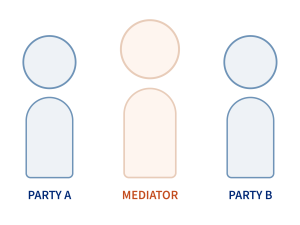
Three people. One conversation. An outcome you both shape.
IN PLAIN TERMS
What mediation is
and what it isn’t
A quick reference for what you can expect — and what mediation will never be.
Mediation is
- Voluntary — you choose to participate
- Confidential — nothing leaves the room
- Collaborative — you shape the outcome
- Affordable — sliding scale and pro bono options
- Fast — most cases resolve in 1″“2 sessions
- Flexible — in person or via Zoom
Mediation is not
- A court hearing where attendance is ordered
- A public legal proceeding on the record
- Arbitration, where someone else decides for you
- Only for people who can afford litigation
- Therapy or counseling for emotional processing
- Legally binding without both parties agreeing
COMPARING YOUR OPTIONS
Mediation, litigation,
counseling — what’s the difference?
Not sure which path is right for your situation? Here’s an honest side-by-side.
Mediation
What LMC provides
- Voluntary — you choose to participate
- Confidential — nothing leaves the room
- Collaborative — you shape the outcome
- Affordable — sliding scale and pro bono options
- Fast — most cases resolve in 1″“2 sessions
- Flexible — in person or via Zoom
BEST FOR
Parties willing to communicate who want to preserve a relationship or resolve a dispute efficiently without a court ruling.
Litigation
Going to court
- Formal — lawyers, judges, hearings
- Public record — open court proceedings
- A judge decides — outcome out of your hands
- Expensive — legal fees can be significant
- Slow — can take months or years
- Adversarial — tends to damage relationships
BEST FOR
Situations where one party won’t negotiate, safety is at risk, or a legally binding court order is specifically required.
Counseling
Mental health support
- Focuses on emotional healing
- Individual or couples — not dispute resolution
- No binding agreement produced
- Long-term — ongoing sessions over months
- Cannot resolve legal disputes
- Confidential — between you and your therapist
BEST FOR
Situations where one party won’t negotiate, safety is at risk, or a legally binding court order is specifically required.
QUICK SELF-ASSESSMENT
Is mediation right
for my situation?
If most of these apply to you, mediation is likely a strong fit. Still unsure? Just reach out — there’s no cost or obligation.
- Both parties are willing (or could be willing) to participate
- You want to control the outcome rather than have a judge decide
- Privacy matters — you’d prefer to keep this out of public records
- You’d like to resolve this without a lengthy, expensive court process
- There’s a relationship worth preserving — co-parent, neighbor, colleague
COMMON QUESTIONS
Everything you want to know
A quick reference for what you can expect — and what mediation will never be.
LMC schedules sessions for a minimum of 4 hours. Family court cases require at least 3 hours by South Carolina law. Sessions can last longer depending on the complexity of the issues.
It can take anywhere from one hour to multiple sessions to come to an agreement.
Fees are assessed on an individual basis using a sliding scale tied to the Federal Poverty Guidelines. At least one party must qualify at Level I, Level II, or Level III for LMC Services. For more information, please see our Fee Information.
Some form of Alternative Dispute Resolution (ADR) is mandatory in all circuit court and family court cases in all 46 South Carolina counties. Additionally, probate and magistrate court judges may order mediation in cases if they deem it necessary.
Parties may request relief from any mediation requirement by motion, and relief shall be given freely for good cause shown.
Yes. Mediation at the Lowcountry Mediation Center is strictly confidential. Personal, financial, and other case-related materials may be shared with the assigned mediator and, in some cases, with law students or mediators-in-training who are observing.
All LMC staff, mediators, and participants involved are bound by strict confidentiality requirements in accordance with South Carolina’s Alternative Dispute Resolution (ADR) Rules. Your privacy and the integrity of the mediation process are our top priorities.
Nobody is required to have an attorney in order to use LMC services. However, it is always recommended that you consult with an attorney if you have a court case pending or if you believe that there will be a court case filed. Then you can make an informed decision about whether to proceed “pro se” (as a “self-represented litigant”) or with an attorney representing you.
The following are four organizations in the Lowcountry, listed in alphabetical order, that provide free/reduced rate legal services:
- Charleston Legal Access (reduced-fee services on a sliding scale based on income and household size, not free)
- Charleston Pro Bono Legal Services (Charleston County only)
- Lowcountry Legal Volunteers
- South Carolina Legal Services
If there is a court order mandating mediation through the LMC by a certain date, and if that date is within 90 days of the date of your request to us, we will schedule mediation in order to comply with the court order. Otherwise, we need both parties to agree to use our services before we will schedule mediation.
Contact us as soon as possible at (843) 972-3683 or info@lowcountrymediation.org. Have your case number and court order ready if possible. We’ll walk you through every step.
Ready to learn more?
See how the process actually works and what types of cases LMC handles.